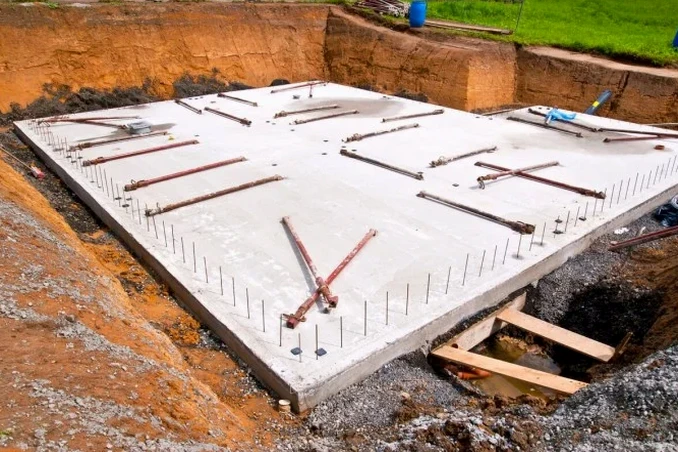
Halifax sits on a peninsula of slate and granite, but the real challenge is what lies on top: a variable blanket of glacial till that can shift from dense lodgement till to loose ablation till within a few meters. Combine that with a frost depth of 1.2 m under the Nova Scotia Building Code, and a conventional spread footing often becomes uneconomical. We routinely specify raft foundations here because they bridge the heterogeneity — spreading the load across a continuous slab that floats over the erratic subsoil. In downtown Halifax projects near the Harbour, infill and marine silts add another layer of complexity that a mat foundation handles better than isolated pads. Before committing to a slab thickness, we almost always pair the design with in-situ permeability testing to confirm drainage assumptions in the till, or with test pits to visually log the transition from weathered slate to competent rock.
A raft foundation in Halifax glacial till can cut excavation costs by 25% compared to deep footings while providing inherent frost protection.
Common questions
What does a raft foundation design package cost for a typical Halifax residential lot?
For a standard residential or light commercial mat foundation in the Halifax area, the design package typically ranges from CA$1,510 to CA$5,740 depending on the complexity of the subgrade conditions. A straightforward site on competent till with a regular footprint falls at the lower end; sites with variable bedrock depth, pyritic slate, or high groundwater near the Harbour require additional modeling and mitigation detailing which pushes toward the upper range.
When is a raft foundation better than strip footings in Halifax?
A raft becomes the better choice when the glacial till subgrade is heterogeneous — think alternating lenses of dense lodgement till and loose ablation till — or when bedrock depth varies significantly across the footprint. It also makes sense on infill sites along the Halifax waterfront where bearing capacity is marginal and differential settlement under individual footings would exceed tolerable limits. The continuous slab bridges these weak zones.
How do you handle the pyritic slate problem in raft foundation design?
Pyritic oxidation in the Halifax Formation slate generates sulfuric acid and expansive sulfate minerals that attack ordinary portland cement. For any raft foundation bearing on or near this material, we specify Type HS sulfate-resisting cement per CSA A23.1, increase the minimum cover to reinforcement to 75 mm, and often include a polyethylene vapor barrier and granular separation layer between the slab and the natural ground. A chemical analysis of the subgrade is standard practice before finalizing the concrete mix design.