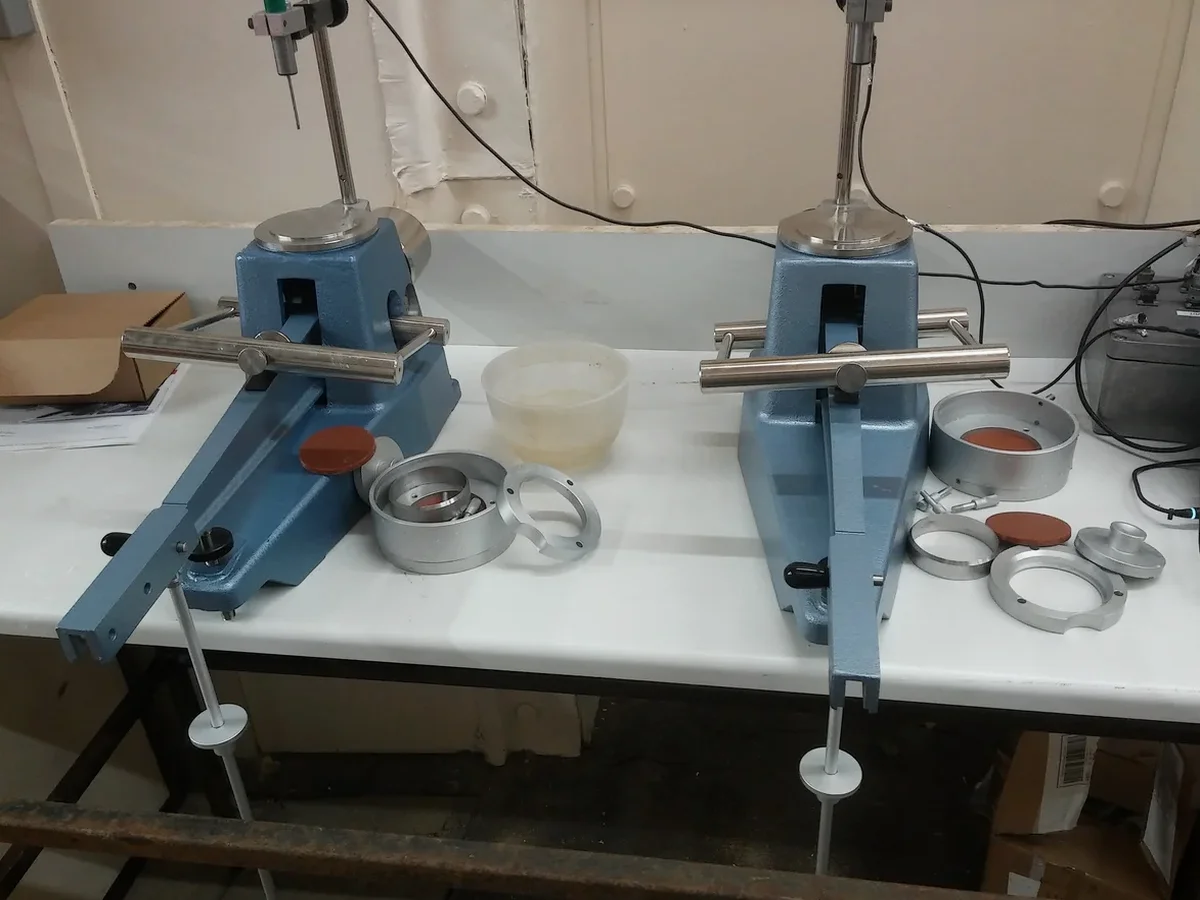
Halifax sits on a complex glacial legacy. The peninsula and surrounding areas are draped with Halifax Formation slate bedrock, but the overburden tells a trickier story — stiff, silty till in some pockets, and sensitive marine clay in others. That clay, deposited when sea levels were higher after the last glaciation, can lose strength dramatically when remolded. Our laboratory team quantifies this behavior through Atterberg limits testing: liquid limit, plastic limit, and plasticity index per ASTM D4318. For sites near the Northwest Arm or Dartmouth crossing, where clay layers vary within a single borehole, these index numbers separate a routine excavation from a costly stability problem. We run the Casagrande cup method and the rolling thread procedure with the same rigor we apply to grain size analysis for complete soil classification under the Unified Soil Classification System.
A plasticity index above 30% in Halifax marine clay signals high swell potential and significant strength loss upon remolding — data that changes foundation depth decisions.
Regional considerations
The Casagrande cup device sits on a hard rubber base, calibrated to drop 10 mm exactly twice per second. The technician adjusts the water content of the soil paste until the standard groove closes over 12.5 mm at exactly 25 blows. On a wet Tuesday in Halifax, with samples arriving from a Sackville residential site, the difference between 24 and 26 blows translates directly into the liquid limit number that governs bearing capacity assumptions. Getting this wrong — or running the test on oven-dried soil that should have been tested at natural moisture — produces plasticity data that understates the risk. Halifax marine clay is sensitive; drying irreversibly changes its structure. Our lab processes samples within 24 hours of extraction, maintaining field moisture and minimizing disturbance. When the plasticity index comes back above 30%, we flag it immediately for the geotechnical engineer, because that soil will swell, shrink, and lose strength in ways that standard bearing capacity equations do not capture.
Regulatory framework
ASTM D4318-17e1 — Standard Test Methods for Liquid Limit, Plastic Limit, and Plasticity Index of Soils, ASTM D2487-17 — Standard Practice for Classification of Soils for Engineering Purposes (Unified Soil Classification System), NBCC 2020 — National Building Code of Canada, Section 4.2 (Geotechnical Considerations)
Common questions
Why do Atterberg limits matter for a foundation in Halifax?
Halifax has extensive deposits of marine clay with liquid limits ranging from 35% to over 60%. A high plasticity index indicates the soil will swell when wet and shrink when dry, imposing seasonal movement on shallow footings. The Atterberg limits also correlate with undrained shear strength and compressibility, which determine the allowable bearing pressure. Without this data, foundation design relies on assumptions that may not hold for the sensitive clays common around the Halifax peninsula and Dartmouth.
How much does Atterberg limits testing cost for a Halifax project?
How long does the test take from sample drop-off to results?
Standard turnaround is three to four business days. The sample must be processed at field moisture, which means we cannot oven-dry and re-wet it without altering the Atterberg limits. For Halifax marine clays, which are sensitive to drying, we prioritize moisture preservation and run the test as soon as the sample enters the lab queue. Expedited two-day results are available on request.
What soil types in Halifax require Atterberg testing?
Any fine-grained soil — silts and clays — should be tested. In Halifax, this typically means the marine clay found across the peninsula, the silty clay layers in the Dartmouth area, and the clay-rich till lenses encountered in Bedford and Sackville. Coarse glacial till with minimal fines may not require Atterberg limits, but if the material passes the No. 40 sieve in significant proportion, the test becomes essential for classification under the National Building Code of Canada.