A six-story residential project on Brunswick Street hit unexpected gray clay at 4 meters—right where the geotechnical report predicted dense till. The contractor lost three weeks waiting for a foundation redesign, and the cost overrun was six figures. That outcome is avoidable. A proper soil mechanics study in Halifax must account for the Drumlin bedrock topography that defines the peninsula, where till thickness varies from 1 to 15 meters over short distances. Our laboratory testing program—including triaxial shear under ASTM D4767 and consolidation per ASTM D2435—provides the parameters engineers need before the excavator arrives. When borehole data shows mixed glacial deposits, we recommend pairing the study with CPT testing to obtain continuous stratigraphy and identify thin compressible layers that conventional sampling might miss. The geotechnical reality of Halifax demands regional experience and precise laboratory methods to avoid surprises.
Effective stress parameters from a well-executed triaxial test can reduce foundation overdesign by 15–20% compared to conservative presumptive values—saving concrete and steel without compromising safety.
Common questions
What does a soil mechanics study in Halifax typically cost for a single-family home project?
How long does laboratory testing take once samples arrive from the field?
Standard index testing (Atterberg limits, grain size, moisture content) is completed within 5–7 business days. Triaxial and consolidation tests require 2–3 weeks because of the saturation, consolidation, and slow shear stages mandated by ASTM D4767 and D2435. We provide preliminary results by email as each test finishes, so the design team can proceed without waiting for the final report.
How many boreholes and samples are needed for a typical Halifax foundation design?
The NBCC 2020 requires a minimum of one borehole per 200 m² of building footprint, with at least three boreholes for any structure. In Halifax, where till thickness varies abruptly, we often recommend closer spacing—one borehole per 150 m²—to capture the bedrock surface relief. Each borehole should yield at least one undisturbed Shelby tube sample per soil layer for triaxial and consolidation testing.
Do you perform the drilling and sampling, or just the laboratory testing?
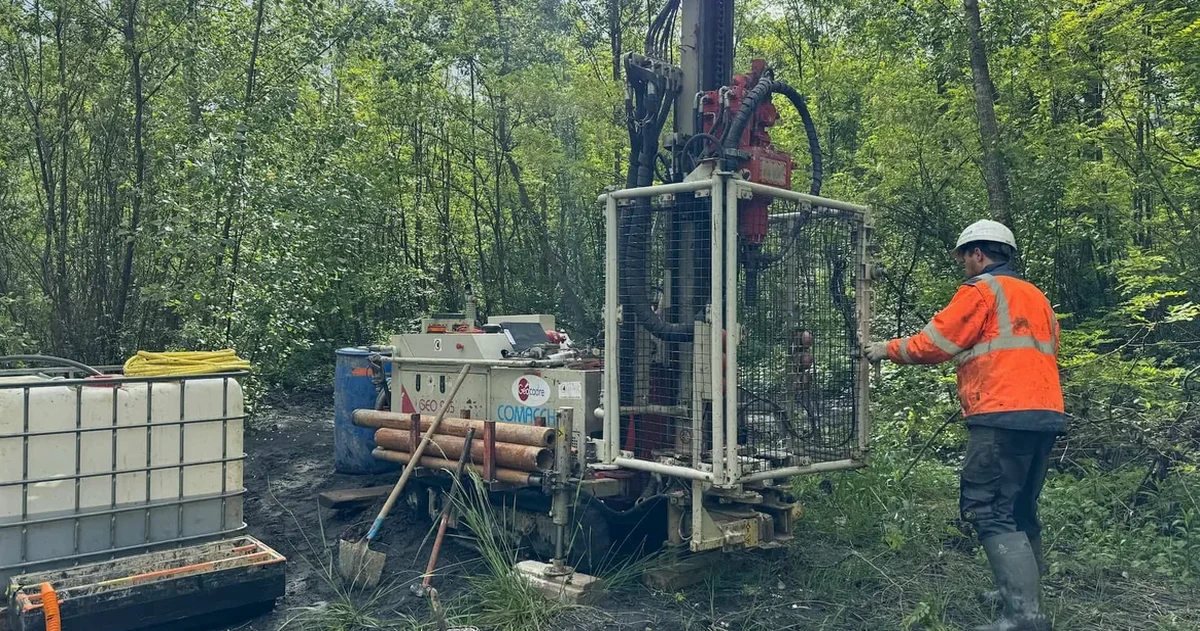
We manage the full investigation: our drilling crew advances boreholes using hollow-stem auger or mud rotary methods through overburden, with NQ coring into bedrock. Undisturbed samples are collected with thin-wall Shelby tubes, sealed with wax, and transported to our laboratory within 24 hours. This integrated approach ensures chain-of-custody and minimizes sample disturbance.