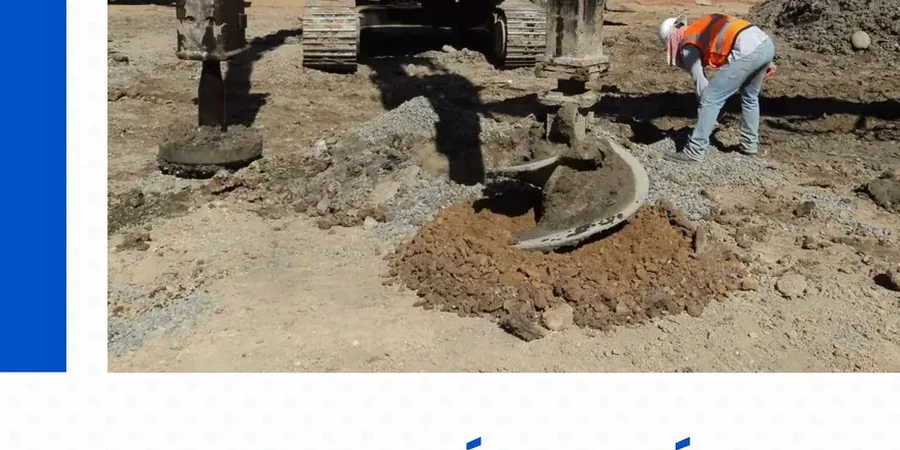
Halifax sits on a drumlin field—glacial till over slate bedrock—but the harbourfront and historic infill zones tell a different story. When the city expanded after the 1917 explosion, debris filled the old shoreline, creating pockets of loose, saturated material that still complicate foundation work today. Our laboratory sees this in every borehole log: three metres of fill, then marine silt, then dense till. A standard footing won't work there. That's where stone column design becomes essential. We combine CPT testing to map the weak layers continuously with laboratory grain-size analysis to confirm the matrix fines content before selecting the vibro-replacement parameters. The NBCC 2015 requires site-specific ground improvement verification, and we deliver that through rigorous sampling and post-installation modulus testing.
A stone column doesn't just densify the soil—it creates a composite mass that drains pore pressure during seismic events, a critical function in Halifax's Seismic Zone 2.
Common questions
How much does a stone column design cost for a Halifax project?
What soil conditions in Halifax make stone columns a good choice?
Stone columns work well in the loose fill and soft marine silts found along the Halifax harbourfront and in older infill zones. The method is suitable for cohesive soils with undrained shear strength above 15 kPa and granular soils with fines content below 15%. In the drumlin till areas further inland, the dense native soil usually doesn't require this treatment.
How do you verify that the stone columns meet the design specification?
We use a combination of methods. During installation, the vibroflot amperage and penetration rate are recorded at each lift. After installation, we perform plate load tests on selected columns to confirm load-deflection behavior. Sand cone density tests check the upper column compaction, and CPT soundings between columns measure the composite soil improvement.
Does stone column design need to account for Halifax's seismic requirements?
Yes. Halifax is in Seismic Zone 2 under NBCC 2015. Stone columns provide an additional benefit: they act as vertical drains during cyclic loading, dissipating excess pore pressure that could trigger liquefaction in loose saturated sands. Our design includes a drainage verification check to confirm the column array can relieve pressure buildup during a design earthquake event.