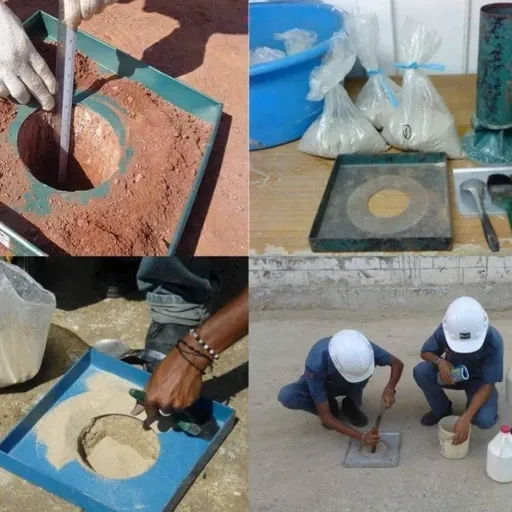
A backfilled service trench that settles six months after paving. It's a common call we get in Halifax, especially around Clayton Park where glacial till can be tricky to compact if moisture isn't just right. The fix is expensive, but the cause is simple: nobody verified the density during backfill. The sand cone test (ASTM D1556) gives you that verification on site, while the soil is still exposed and can be reworked. We run these tests across HRM, from Dartmouth crossing to the waterfront infill zones, and we pair them with Proctor tests to establish the reference curve before field checks begin. For granular subgrades under footings, we often recommend cross-checking with grain size analysis to confirm the material matches the spec before compaction even starts.
A sand cone test gives you one number that can save a failed compaction rework—worth ten times the test cost on any Halifax project with fill.
Process and scope
A four-story mixed-use building on Robie Street with a compacted gravel pad for a mat foundation. The structural engineer specified 98% modified Proctor density, and the sandy gravel from a local quarry looked good on paper. But the first sand cone test at 30 cm depth showed only 91%. Why? The lift was too thick for the roller they were using—a classic mistake in tight urban sites where access limits equipment size. We flagged it immediately, the contractor reduced lift thickness to 15 cm, and the retest passed. This is what the sand cone method does well: it gives you a direct, physical measurement of in-place density that no nuclear gauge can match for dispute resolution. The test works on fine-grained soils and granular fills alike, though for very coarse material we adjust the calibration sand gradation. It's a simple principle—excavate a precise hole, weigh the removed soil, measure the hole volume with calibrated sand, calculate dry density—but the execution requires careful technique and a lab that maintains tight calibration records. Our field techs carry calibrated sand lots and pre-weighed jars to every site, and the sand is checked for gradation drift every 20 tests as ASTM requires.
Regional considerations
Halifax sits on a complex glacial geology—drumlins of dense lodgement till, pockets of loose ablation till, and marine silts in low-lying areas near the harbour. The till can hold a dense, overconsolidated structure that looks competent but breaks down when remolded and recompacted, making field density verification essential on any engineered fill. In the Bedford Basin area, soft marine clays underlie many sites; placing structural fill over these soils without documented compaction invites differential settlement that shows up within the first two winters of freeze-thaw cycling. A single failed density test on a footing subgrade can trigger re-excavation, re-compaction, and re-testing—delaying your concrete pour by days. For deep infrastructure like sewer trenches in Sackville or Spryfield, we recommend coordinating density tests with in-situ permeability checks to ensure the compacted backfill also meets drainage specs required by Halifax Water.