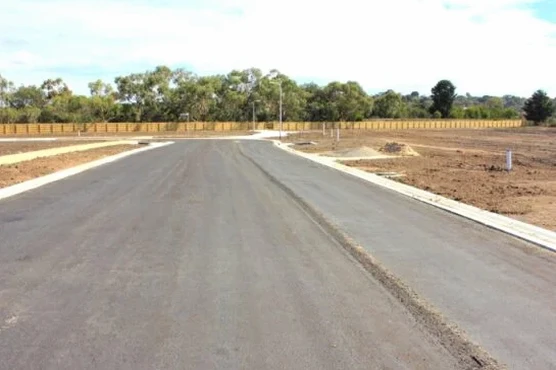
Halifax sits on a complex glacial legacy that makes rigid pavement design a different discipline from what you’d encounter in, say, the prairies. The city’s terrain is dominated by drumlins and slate bedrock draped with a thin, stony till, while low-lying areas near the Northwest Arm and Bedford Basin hide compressible marine clays that deform under sustained load. In our experience, a rigid pavement section that performs brilliantly on the granitic outcrops of Clayton Park will fail within three seasons if placed on the grey silts of Burnside without a proper subgrade investigation. The freeze-thaw cycling that comes with Halifax’s coastal winters—where temperatures oscillate around zero for weeks—generates differential heave that demands precise joint detailing and solid base drainage. Whether the project is a container terminal at the Port of Halifax or a fire-access lane in Spryfield, we approach every concrete pavement with an understanding that the subgrade, not the slab, dictates long-term performance. Before committing to a rigid section, it is often prudent to compare the soil’s response with data from in-situ permeability testing to anticipate drainage behavior under the slab.
A rigid pavement in Halifax lives or dies by its joint detailing and subgrade drainage—never by the concrete strength alone.
Process and scope
The bedrock in central Halifax is predominantly Meguma Group slate and quartzite, which provides excellent bearing but creates an abrupt stiffness contrast when pavement transitions from cut to fill sections. This differential settlement, combined with the aggressive chloride exposure from sea spray along the waterfront, drives our reinforcement strategy. We routinely specify thicker edge sections and dowel retrofits for pavements within five hundred metres of the harbour. In our recent work, we’ve correlated field performance with laboratory compaction curves from
Proctor tests to validate the subbase modulus assumed in ACI 360R-10 and AASHTO 93 design equations. A typical Halifax rigid pavement section incorporates a 200–250 mm concrete slab over a 150 mm granular subbase, but the numbers shift dramatically on the compressible clays found in Dartmouth Crossing and parts of Eastern Passage, where we often recommend cement-stabilized working platforms beneath the slab. The maritime humidity also accelerates alkali-silica reaction in some local aggregates, so we specify low-alkali cement and supplementary cementitious materials as standard practice. For industrial yards with heavy forklift traffic, joint layout must account for the tight turning radii of container handlers, which impose significant corner stresses not captured by simplified Westergaard models. Where subgrade conditions are particularly challenging we integrate findings from
stone columns ground improvement campaigns to achieve the required modulus of subgrade reaction.
Common questions
What is the typical rigid pavement design life for a Halifax arterial road?
We target 30 to 40 years for arterial concrete pavements designed to AASHTO 1993 methodology, provided the subgrade is properly prepared and joints are maintained. The maritime freeze-thaw environment means joint sealant replacement cycles are shorter than inland—typically every 7 to 10 years.
How does the marine climate affect rigid pavement durability in Halifax?
Coastal Halifax exposes concrete to airborne chlorides, frequent freeze-thaw cycles, and high humidity. We specify air-entrained concrete with a water-cement ratio not exceeding 0.40, low-alkali cement to mitigate ASR with local aggregates, and epoxy-coated reinforcement when the slab is within the harbour spray zone.
Do you need soil investigation before designing a rigid pavement in Halifax?
Absolutely. The variability between competent slate bedrock, stiff drumlin till, and soft marine clays across the city means that a design based on assumed subgrade properties will either be uneconomical or unsafe. A site-specific investigation with test pits and laboratory Proctor and CBR testing is the minimum we require.
Can rigid pavement be used for residential driveways in Halifax?
Yes, concrete driveways perform well in Halifax if detailed correctly. We recommend a minimum 125 mm slab thickness, 150 mm granular base, and a single control joint every 3 to 4 metres. The key is positive drainage away from the slab edges to prevent frost jacking at the perimeter.
What is the cost range for rigid pavement design services in Halifax?