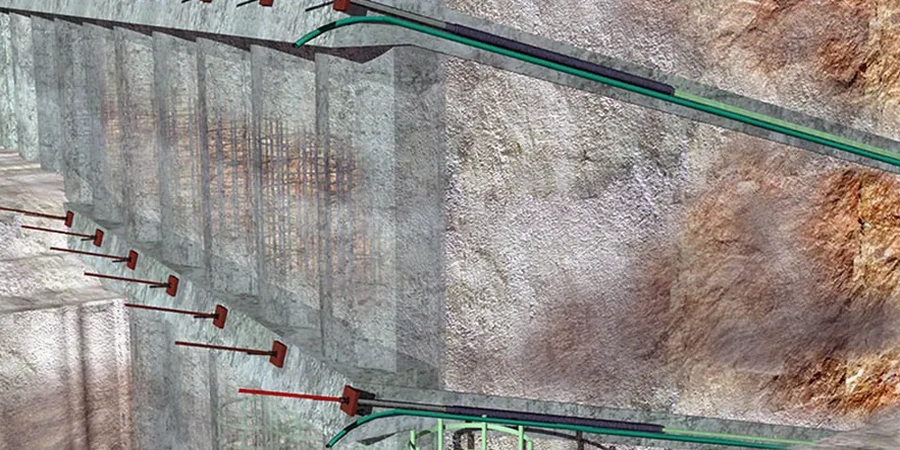
The South End and Bedford sit on very different ground, even though they\u2019re twenty minutes apart. One is classic Halifax slate, grey and tightly folded, while the other is glacial till that shifts from bouldery to silty within a single block. Anchor design has to respond to that. A passive anchor grouted into weathered slate behaves nothing like one socketed into dense till, and the load-transfer mechanism changes completely. We see this every week on sites from Purcells Cove to Larry Uteck. Getting the bond length right, and knowing where the groundwater is moving through the fractures, is the difference between a tieback that holds and one that creeps. Our Halifax-based team combines in-situ permeability testing with FHWA-recommended bond stress verification to size anchors correctly for the local formation.
When a tieback fails in Halifax, it\u2019s rarely the steel. It\u2019s almost always the bond zone in weathered slate that wasn\u2019t characterized properly.
Common questions
What\u2019s the difference between active and passive anchors?
Active anchors are tensioned with a jack after grouting, so they apply an immediate compressive force to the wall or slope. Passive anchors aren\u2019t tensioned; they only mobilize resistance when the ground starts to move. In Halifax, we use active anchors where adjacent buildings can\u2019t tolerate any movement, and passive anchors for cut slopes where some deformation is acceptable.
How deep do anchors need to go in Halifax bedrock?
It depends on the rock quality and the design load, but typical bond lengths in Halifax Group slate run between 3 and 6 metres. We verify that with a geotechnical investigation, often including core drilling and pressuremeter testing, to confirm the RQD and the bond stress capacity.
What does anchor design cost in Halifax?
Are active anchors considered permanent?
They can be, if designed with proper corrosion protection. For permanent applications we specify double encapsulation (Class I) per PTI recommendations, and we often include a monitoring plan with periodic lift-off checks to confirm the lock-off load hasn\u2019t decayed.