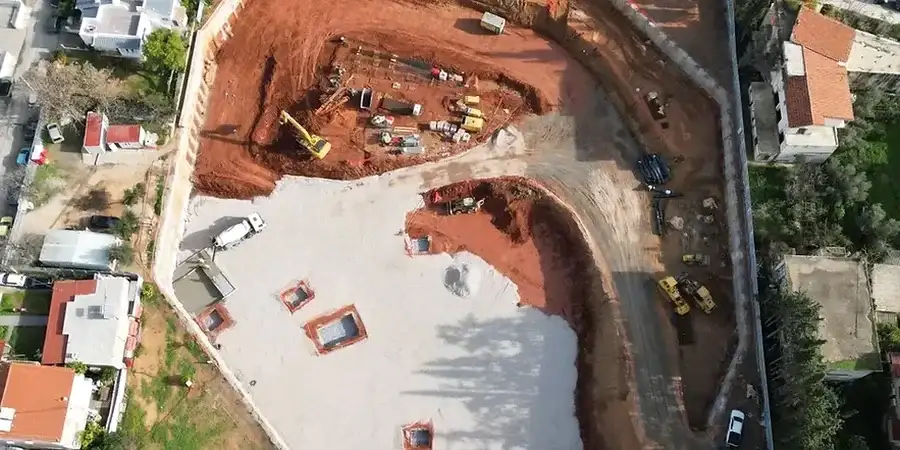
You can drive ten minutes in Halifax and go from the dense glacial till of Clayton Park to the slate bedrock outcrops of Purcell's Cove. The difference under the surface is night and day, and it changes everything about how a deep excavation behaves. On the peninsula proper, we deal with the layered legacy of the Wisconsin glaciation: stony tills draped over folded slate and quartzite of the Meguma Group. Down by the waterfront, you might hit marine clay layers that need a completely different shoring strategy than what works up near the Armdale Rotary. Our team has been through enough basements and pump station digs in this city to know that every excavation here tells a local story, shaped by bedrock depth, groundwater recharge from the lakes, and the freeze-thaw cycles that crack exposed rock faces within hours. Before mobilizing rigs for a shoring design, we often run a CPT test to map soft zones in the till, and cross-reference with MASW surveys when the site is tight on space between heritage buildings.
In Halifax, shoring design is less about textbook formulas and more about understanding how the till drains and where the slate is going to surprise you.
Process and scope
What we see repeatedly across HRM is that groundwater pressure behind soldier pile walls gets underestimated until you hit the first real storm. The till here can be deceptively well-drained in summer, but come November, the perched water tables rise fast. That's why we design drainage systems that account for the full hydrostatic profile, not just the dry-season reading. Our approach leans heavily on observational method: install inclinometers and piezometers early, model the staged cut sequence in PLAXIS or FLAC, and compare the predicted lateral movements against real-time data. We've worked with everything from conventional tieback anchors drilled into the Halifax slate to secant pile walls where you're excavating next to occupied structures on Barrington Street.
The bedrock quality varies enormously: fresh, massive slate in some pockets, highly weathered and folded in others. Socketing soldier piles into rock that's RQD 20 versus RQD 80 demands two completely different designs. We apply the NBCC 2020 seismic provisions and CSA A23.3 for reinforced concrete components of the shoring system, and reference FHWA guidelines for anchored wall systems when the excavation exceeds 6 meters in depth.
Common questions
What geotechnical investigation is required before designing a deep excavation in Halifax?
We typically require a minimum of two deep boreholes within the excavation footprint, extending at least 3 meters below the proposed subgrade into competent bedrock. Standard testing includes SPT N-values in overburden, PQ/HQ core recovery with RQD measurement in rock, and installation of standpipe or vibrating wire piezometers to establish the seasonal groundwater profile. In areas near the harbour or infilled ravines, we add CPT soundings to delineate soft clay lenses and cross-hole seismic testing where rock rippability is a concern.
How do you account for the variable bedrock quality in Halifax when designing shoring?
We map the bedrock surface and joint orientation from core logging and, where possible, from exposed outcrops adjacent to the site. The design socket length for soldier piles or secant piles is based on the lower-bound RQD and the orientation of dominant joint sets relative to the excavation face. If the bedrock is highly fractured with RQD below 25, we switch from passive resistance assumptions to a tied-back or braced system that does not rely solely on socket capacity. We also specify rock dowels and shotcrete facing as contingency measures if degradation is observed during construction.
What is the typical cost range for deep excavation design services in Halifax?
For a comprehensive geotechnical design package including shoring, dewatering, and staged excavation analysis, fees generally range from CA$2,730 to CA$11,380 depending on excavation depth, complexity of the ground model, and the level of construction-phase monitoring required. A simple single-level basement design falls at the lower end, while a multi-level deep excavation with tiebacks and real-time instrumentation support reaches the upper range.
What lateral movement limits do you design for when excavating next to existing buildings?
We follow the movement criteria established in FHWA GEC 2 and local practice: for buildings with brittle finishes or unreinforced masonry, we limit lateral movement to 25 mm and angular distortion to 1/500. For modern reinforced concrete or steel-frame structures adjacent to the cut, we may allow up to 50 mm of lateral movement, provided that the settlement profile is gradual. Every design includes a trigger-action response plan that ties specific movement thresholds to pre-agreed mitigation measures.