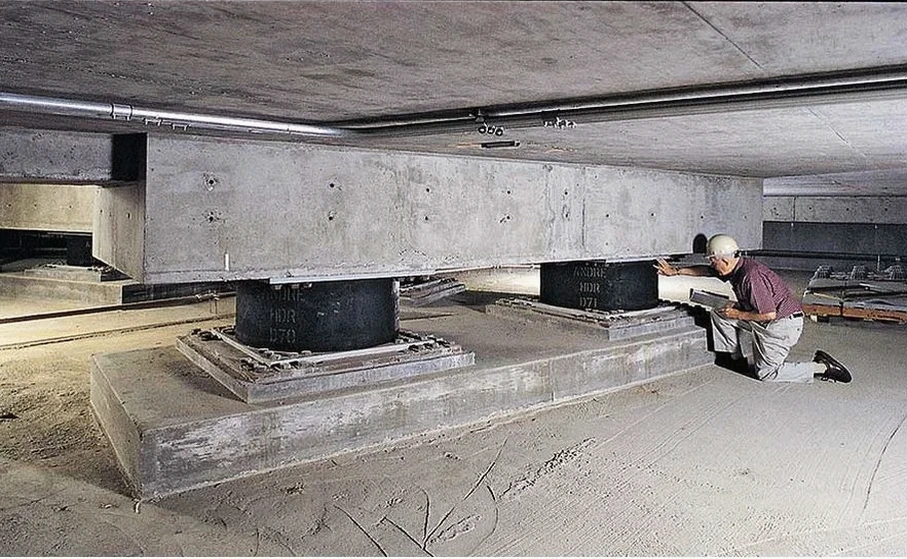
The most expensive mistake we see in Halifax is the assumption that moderate seismicity eliminates the need for advanced protection. Design teams treat the 2% in 50-year hazard as a check-box exercise, then wonder why cladding cracks appear after a modest tremor off the Scotian Shelf. Base isolation changes that arithmetic entirely. By decoupling the superstructure from ground motion using friction pendulum bearings tuned to the site-specific spectra from NBCC 2020, we routinely cut inter-story drift by half and protect non-structural investment—MEP systems, architectural finishes, historical fabric—from damage that conventional fixed-base design simply accepts. On the metamorphic bedrock of the Halifax Peninsula, where short-period amplification can surprise engineers unfamiliar with the local velocity profile, a properly designed isolation plane becomes the difference between immediate re-occupancy and months of litigation.
A well-tuned isolation system in Halifax reduces spectral acceleration at the superstructure level by 60-70%, effectively downgrading the design earthquake to a service-level event for the building envelope.
Regional considerations
When we mobilize a base isolation project in Halifax, the physical centerpiece is the full-scale bearing test rig—a servo-hydraulic actuator array capable of applying 10,000 kN vertical load while cycling horizontal displacement at 600 mm amplitude. This equipment validates every isolator batch before it ships to the site, because a bearing that passes the factory QA but behaves differently at 5°C installation temperature can compromise the entire isolation plane. The greater risk, however, sits in the superstructure interface: a rigid diaphragm assumption that ignores the flexibility of the isolation moat cover plates can introduce unintended pounding against the retaining wall at the perimeter. We detail these covers with a sliding joint that accommodates the full MCE displacement plus a 15% buffer, and we verify the dynamic gap through nonlinear time-history analysis using ground motions matched to the NBCC uniform hazard spectrum for the Halifax grid coordinate. Ignoring this interface detail has caused water intrusion and corrosion in at least two Canadian projects we have been called to remediate.
Regulatory framework
NBCC 2020 Part 4 – Seismic Design provisions with site-specific hazard values for Halifax (lat 44.65°N), CSA S6:19 Canadian Highway Bridge Design Code – Section 4 Seismic Isolation for bridge applications, ASCE/SEI 7-22 Chapter 17 – Seismic Isolation and Energy Dissipation (adopted as best practice for buildings), ISO 22762-1:2018 – Elastomeric seismic-protection isolators, Part 1: Test methods, ASTM D4014 – Standard Specification for Plain and Steel-Laminated Elastomeric Bearings for Bridges
Common questions
Is base isolation justified for a mid-rise building in Halifax, given the moderate seismicity?
For essential facilities, post-disaster structures, and buildings with high-value contents or heritage fabric, the business case is strong. The incremental cost of isolation—typically 2-4% of structural frame cost—pays back through reduced post-earthquake downtime and lower long-term insurance premiums. We perform a life-cycle cost analysis as part of the feasibility phase to quantify this return for the specific occupancy class.
What is the typical cost range for base isolation design and testing on a Halifax project?
For a mid-rise structure requiring full nonlinear analysis, isolator procurement support, and construction-phase testing oversight, the engineering fee typically ranges from CA$5.060 to CA$11.080 depending on the number of isolator types, the complexity of the moat detailing, and the extent of peer review required by the authority having jurisdiction.
How do you handle the stiffening of elastomeric bearings during Halifax winter conditions?
We specify low-temperature compounds tested per ISO 22762-1 Annex C, with crystallization resistance verified at -25°C. The effective shear modulus increase at low temperature is incorporated into the upper-bound property set used for the wind-lock and serviceability checks, so the isolation system remains functional across the full -20°C to +30°C range expected in the harbour microclimate.