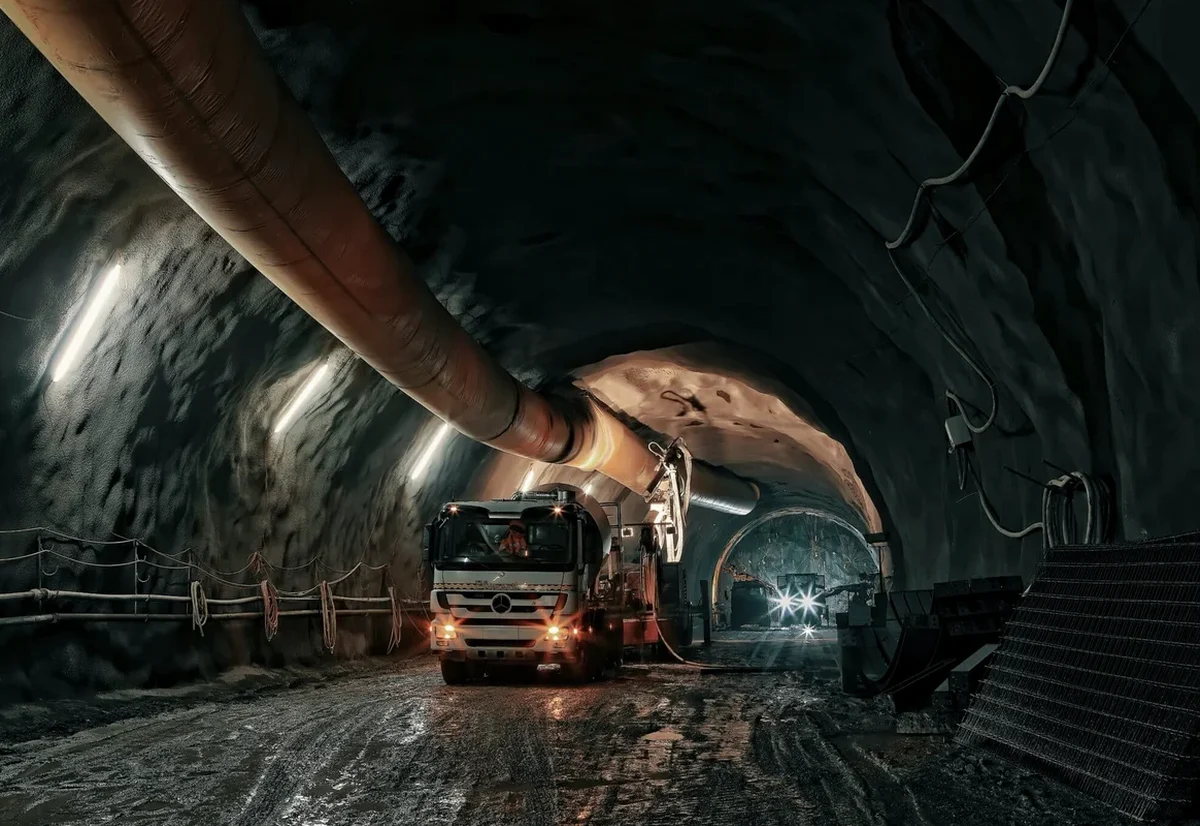
Halifax's urban core sits on a narrow peninsula, forcing infrastructure expansion into marginal ground once avoided. The railway cut through the South End exposed the classic profile: dense glacial till over sheared slate, with pockets of compressible organic silt near the harbour. Tunnels here, whether for combined sewer overflow storage or future transit corridors, pierce exactly those weak zones. The technical challenge is not rock strength. It is the transition from stiff till to soft marine clay over less than twenty metres, a condition that demands precise CPT testing to map pore pressure dissipation and undrained shear strength before any face stabilization design begins. Without this data, settlement predictions become guesswork.
In Halifax's glacial terrain, tunnel face stability is controlled not by average strength but by the water pressure in discrete silt seams.
Common questions
What is the typical depth of bedrock across the Halifax peninsula?
Bedrock depth varies sharply. In the South End near Dalhousie University, slate is often encountered within three to five metres. Moving east toward the harbour, the till thickens, and bedrock can drop below twenty-five metres. Near the historic stream valleys, buried channels push bedrock even deeper. Each tunnel alignment requires closely spaced borings because depth changes rapidly.
How do you handle the acidic groundwater from pyritic slate?
The pyritic slate of the Meguma Group oxidizes upon excavation, generating sulfuric acid. We test groundwater pH during the site investigation phase. When pH falls below 4.5, we specify a concrete mix with sulfate-resistant cement per CSA A23.3 Class S-2 or S-3. For steel components, we require a minimum 100-micron epoxy coating or full stainless steel in the invert.
Is numerical modelling required for small-diameter tunnels?
For microtunnels and small-diameter utility bores under two metres, empirical methods based on N-values and undrained shear strength often suffice. However, if the tunnel passes beneath a heritage building or within two diameters of an existing foundation, we strongly recommend a 2D finite element model to quantify settlement and verify that angular distortion stays below 1/500.
What budget range should we expect for a soft ground tunnel investigation in Halifax?
A thorough investigation including boreholes, laboratory testing, and a final geotechnical interpretive report typically falls between CA$6,400 and CA$24,640, depending on the number of boreholes, the depth to bedrock, and the required laboratory testing suite. Projects requiring cross-hole seismic or pressuremeter testing fall at the upper end of this range.