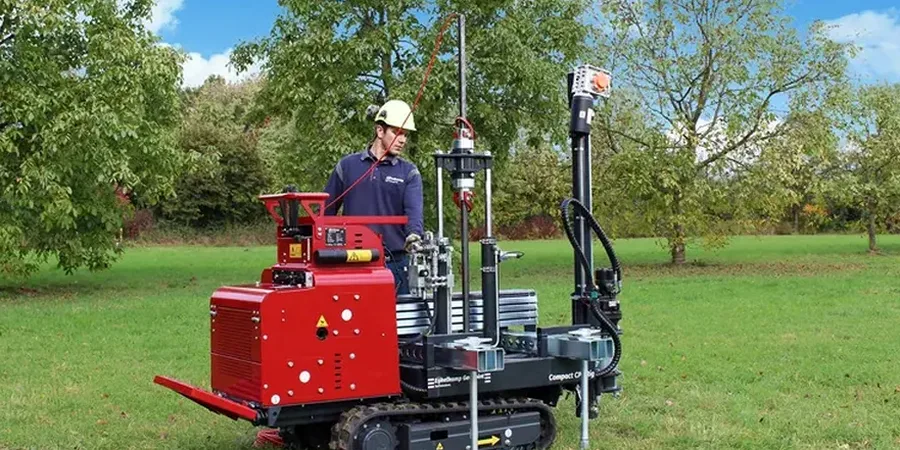
Halifax sits on a complex mix of Cambrian slate, granite, and thick glacial till left by the last ice retreat. Slope failures along the Bedford Basin and variable fill depths on the peninsula make foundation design difficult without real soil behavior data. In 2023 alone, over 1,200 building permits were issued in the municipality, many on lots where standard boreholes miss thin, weak layers. CPT testing fills that gap. Our team runs cone penetration tests that capture continuous tip resistance, sleeve friction, and pore pressure — every 2 cm. For sites near the harbor where marine clay interbeds cause differential settlement, we combine CPT soundings with a seismic microzonation review to lock down site class per NBCC 2020. When bedrock is shallow in the south end, we shift to a compact 20-ton rig that pushes through till without predrilling. The result is a stratigraphic log that leaves no surprises.
Two centimeters of vertical resolution across 30 meters of depth — that's the kind of data that catches the thin silt seam before it catches your foundation.
Regulatory framework
ASTM D5778-20 Standard Test Method for Electronic Friction Cone and Piezocone Penetration Testing of Soils, NBCC 2020, Division B, Part 4 for seismic site classification via shear wave velocity correlation, CSA A23.3-19 Design of Concrete Structures (foundation bearing input from CPT data), ISO 22476-1:2012 Geotechnical investigation and testing — Field testing — Electrical cone and piezocone penetration test
Common questions
How much does a CPT test cost in Halifax?
Most residential and small commercial CPT soundings in HRM run between CA$220 and CA$380 per location, depending on depth, access, and whether you need standard CPT or piezocone with dissipation. Mobilization within the peninsula is typically included; sites outside the core may add a travel surcharge. A formal quote comes free after a quick call to review your site address and target depth.
How deep can you push the cone in Halifax till?
In the dense Lawrencetown till common across the metro area, our 20-ton rig typically reaches 12 to 18 meters before tip resistance exceeds capacity. Where till is thin and weathered, we often push through to bedrock at 6 to 10 meters. If you need deeper profiles, we recommend pairing CPT with a rotary drill program for the rock portion.
Do you need a drill rig to start CPT?
No pre-drilling in most cases. The cone is pushed directly from surface using hydraulic rams anchored by the rig's weight. Only when we encounter cobble-rich till or fill with boulders do we pre-drill a short starter hole — and we'll confirm that on site rather than scheduling it unnecessarily.
Can CPT data replace SPT for foundation design?
In many Halifax soils, yes. CPT gives continuous data while SPT gives values every 1.5 meters, so thin weak layers are easier to miss with hammer-driven sampling. However, some engineers still want SPT for direct N-value correlations. We can run both on the same site; CPT often reduces the number of SPT boreholes needed.
What's the turnaround time for CPT results?
Raw data plots are available the same day. Processed logs with soil behavior type classification and interpreted geotechnical parameters — undrained shear strength, relative density, constrained modulus — are delivered within two business days. Rush interpretation for urgent foundation decisions can be turned around in 24 hours.