← Home · Investigation

SPT Testing in Halifax — Penetration Resistance for Real Ground Conditions

Together, we solve the challenges of tomorrow.

LEARN MORE →

Halifax sits on a geological puzzle that keeps every geotechnical engineer honest — from the granite outcrops of Purcells Cove to the compressible marine silts blanketing the downtown core. With over 440,000 people in the regional municipality and a construction pace that hasn't slowed since the 2020s, getting the subsurface right before excavation starts isn't optional. The Standard Penetration Test remains the industry workhorse here because it delivers N-values and disturbed samples in a single run, and the results feed directly into bearing capacity checks under NBCC 2015 Part 4. Our lab team runs SPT rigs calibrated to ASTM D1586-18 with automatic trip hammers, and we've pulled split-spoon samples from depths exceeding 30 metres in Dartmouth's harbourfront fill zones. When the till layer is thin and refusal hits shallow bedrock — common on the Peninsula — we often pair SPT data with seismic refraction to map the rockhead profile without extra drilling.

An SPT refusal on Halifax slate doesn't mean the investigation is over — it just tells you where the real engineering questions begin.

Methodology and scope

We worked a site on Barrington Street last winter where the borehole log showed seven metres of loose sandy silt before hitting the typical Halifax slate. The contractor needed to confirm that vibro-compaction would densify the upper layer enough to support a five-storey mixed-use structure. We ran SPT at 1.5-metre intervals through the silts, then switched to HQ coring once the split-spoon refused on weathered bedrock. The N-values jumped from 6 to refusal within 60 centimetres — that transition zone is exactly where Halifax foundations get tricky. One thing we've learned from hundreds of holes across the city: the till matrix varies enormously depending on whether you're on the drumlin field near Clayton Park or the eroded coastal plain along the Northwest Arm. For projects where the granular fraction dominates and drainage becomes a design concern, we recommend supplementing the SPT program with in-situ permeability testing to get field hydraulic conductivity rather than relying on correlations from grain-size curves alone.
SPT Testing in Halifax — Penetration Resistance for Real Ground Conditions
Technical reference image — Halifax

Local considerations

Halifax weather doesn't just make site access miserable between November and April — it actively changes the ground. The freeze-thaw cycles that rip apart asphalt on Robie Street also create temporary perched water tables in the overburden, and an SPT value obtained in saturated October till can look completely different from one taken in frozen February ground. We've seen N-values swing by 30 percent in the same formation depending on pore pressure conditions at the time of drilling. Harbour-front projects face an additional layer of complexity: the historic fill along the waterfront contains everything from ballast cobbles to 19th-century timber cribbing, and hitting obstructions mid-test can damage split-spoon shoes or give false refusal readings. That's why we log every run with detailed driller notes — auger chatter, rod bounce, water level changes — so the geotechnical engineer interpreting the log understands what the numbers actually represent. In areas with documented marine clay sensitivity near Bedford Basin, the SPT data also feeds into liquefaction assessment using the Youd-Idriss framework adapted for the NBCC seismic hazard values assigned to Halifax Regional Municipality.

Need a geotechnical assessment?

Reply within 24h.

Email: contact@geotechnicalengineering.vip

Technical parameters

ParameterTypical value
Hammer typeAutomatic trip, 63.5 kg weight, 760 mm drop
Split-spoon samplerStandard 50 mm OD, 35 mm ID, 610 mm length
StandardASTM D1586-18
Reporting parameterN-value (blows/300 mm), N60 energy-corrected
Typical depth range in Halifax3 m to 35 m, bedrock refusal common 5–15 m
Sampling interval1.5 m continuous, tighter at stratum boundaries
Sample recoveryDisturbed, bagged, chain-of-custody for lab testing

Associated technical services

01

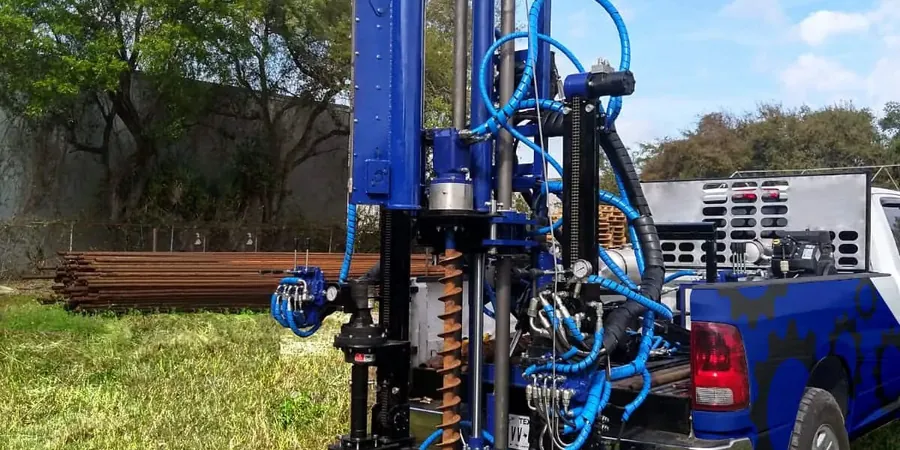
SPT drilling with automatic hammer

Track-mounted and truck-mounted rigs equipped with ASTM D1586-compliant automatic trip hammers. Continuous sampling at 1.5 m intervals, with N-values corrected for energy efficiency and overburden pressure in the final report.

02

Bedrock refusal assessment

When the split-spoon refuses on Halifax slate or granite, we switch to diamond coring to confirm bedrock quality. The transition depth is critical for end-bearing pile design on Peninsula sites.

03

Combined SPT and laboratory testing

Disturbed samples recovered during SPT can be routed directly to our accredited lab for grain-size analysis, Atterberg limits, and moisture content — all under chain-of-custody documentation.

04

Liquefaction screening with SPT data

For sites near the harbour, Bedford Basin, or infilled watercourses, we process N-value profiles through NBCC-compatible liquefaction triggering analyses to flag potentially unstable layers before structural design proceeds.

Applicable standards

ASTM D1586-18: Standard Test Method for Standard Penetration Test, NBCC 2015 Part 4: Structural Design — foundation bearing capacity from SPT N-values, CSA A23.3: Design of concrete structures — pile design correlations with SPT data, NCEER/Youd-Idriss 2001: Liquefaction resistance from SPT blow counts

Frequently asked questions

What does SPT testing cost for a typical Halifax residential lot?

For a standard single-family residential investigation in Halifax — usually one or two boreholes to 10–15 metres — you're looking at CA$640 to CA$1.080 depending on access constraints, depth to refusal, and whether we're drilling on the Peninsula versus out toward Spryfield where the terrain is more open. The price includes the rig, operator, split-spoon sampling at 1.5 m intervals, field logs, and the signed engineering report with N-values and soil descriptions.

How do Halifax's glacial soils affect SPT N-value interpretation?

The drumlin till that covers much of HRM has a dense, overconsolidated matrix with erratic cobbles and boulders. N-values in this material often exceed 50 blows before the full 300 mm penetration, and you'll see sharp spikes where the sampler hits a granite cobble followed by a drop when it passes into finer matrix. Our logs flag these anomalies explicitly so the designer doesn't misinterpret a cobble hit as a competent bearing stratum.

Can you drill SPT boreholes in winter on Halifax Peninsula?

Yes, we operate year-round in HRM. The main winter challenge on Peninsula sites is tight laneway access when snowbanks narrow the clearance, so we bring a compact track rig that fits through a standard residential gate. Frozen ground at the surface doesn't affect SPT results below the frost line, though we do note surface conditions and thaw depth on the log for transparency.
Location and service area

We serve projects across Halifax and surrounding areas.

View larger map