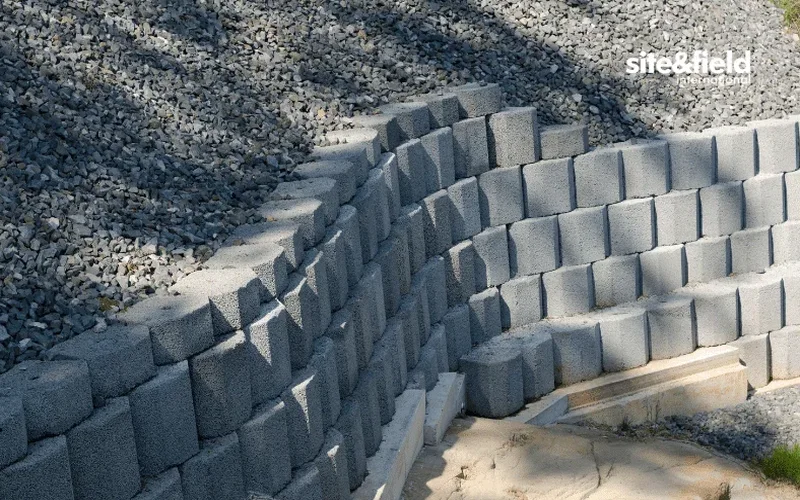
A residential developer on Purcells Cove Road needed a 4.2 m wall to terrace a sloped lot. The bedrock was close to surface — just 1.8 m down — but the overburden was a dense glacial till with cobbles. That combination changes everything. Standard cantilever assumptions fail when granite is that shallow. We ran direct shear on the till, logged the bedrock interface, and sized the footing to bear on the rock. Halifax geology does not give you uniform conditions. The Halifax Formation slate and granite dominate the peninsula, but coastal areas contain marine clay pockets. Our retaining wall design ties laboratory data to site reality. We do not use textbook soil profiles. We use Atterberg limits data from the exact borrow source and strength parameters from the exact excavation line. That is the only way to get a wall that stands through freeze-thaw cycles and nor'easter storms.
A retaining wall in Halifax must handle more than lateral earth pressure — it has to survive freeze-thaw, salt-laden moisture, and the occasional nor'easter all in one season.
Process and scope
Halifax sits on the edge of the Atlantic. Wet winters, salt spray, and rapid snowmelt saturate backfill fast. Drainage design is not optional here — it is the first thing we specify. Every retaining wall design we produce includes a drainage layer, weep holes or strip drains, and a filter gradation matched to the backfill. We test the backfill material in our lab. If the fines content exceeds 5%, we reject it or redesign the drainage. Another local factor: frost penetration reaches 1.2 m in open terrain. The wall footing must be below that depth or protected by rigid insulation. We follow NBCC 2015 Division B Part 4 for structural loads and CSA A23.3-14 for concrete design. For segmental block walls, we check NCMA design methodology. No generic approaches. The wall geometry, reinforcement, and embedment are calculated for the specific soil unit mapped at your site. We also factor in the proximity of bedrock — many Halifax lots have rock within 2 m of grade, which changes the failure plane assumptions drastically.
Regional considerations
The number one problem we see in Halifax retaining walls is water behind the wall. Homeowners call us when the wall starts leaning forward in March. We excavate and find the backfill is saturated, the weep holes are clogged, and there is no filter fabric. Another issue: walls built on fill. Some older neighborhoods — parts of Dartmouth and the West End — have up to 3 m of uncontrolled fill. That material settles, creeps, and provides poor bearing. We specify a soil investigation before any wall goes in. If fill is found, we either remove it, over-excavate and replace with structural fill compacted to 95% Standard Proctor, or we design a deeper foundation. Frost heave is a third failure mode. A wall footing placed at 0.6 m depth will lift in February and crack by March. It happens every year. Our designs always place the bearing surface below the local frost line.
Common questions
How much does retaining wall design cost in Halifax?
Typical design packages run from CA$1,270 for a simple gravity wall under 1.2 m to CA$5,730 for a reinforced cantilever or anchored wall with full lab testing. The final figure depends on wall height, site access, and how much soil testing is needed.
Do I need a building permit for a retaining wall in Halifax?
HRM requires a building permit for any retaining wall over 1.2 m in height, or any wall supporting a surcharge like a driveway or building. Our sealed design meets the submission requirements for the permit office.
What soil information do you need before designing the wall?
We need a borehole or test pit at the wall alignment. Minimum data: soil type and unit weight, drained friction angle from direct shear, bedrock depth, and groundwater level. We collect all of this during the site investigation.
How long does the design process take?
Site investigation takes one day. Lab testing runs 5 to 7 business days. The design and sealed report are ready 10 to 12 business days after the site visit, assuming no unexpected soil conditions.