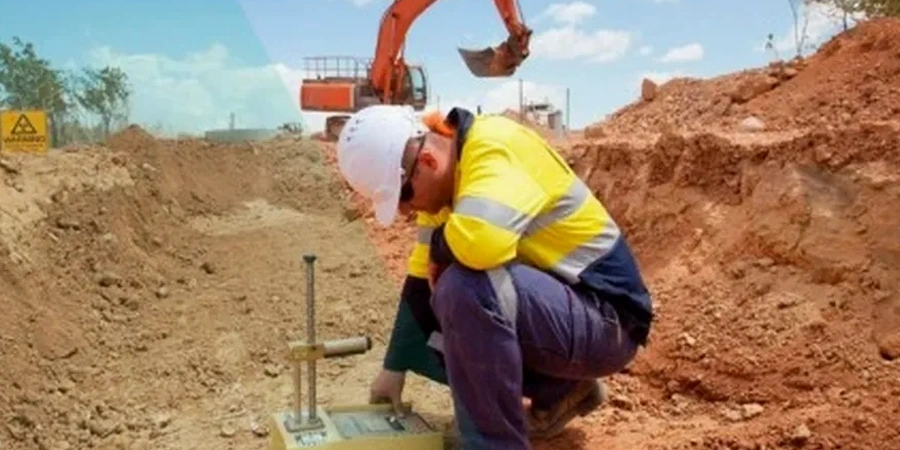
Halifax sits on the edge of the Canadian Shield but also over deep glaciomarine sediments that tell a complex story every time seismic waves pass through. The 1929 Grand Banks earthquake—magnitude 7.2—was felt strongly here despite the epicenter being hundreds of kilometers away, a reminder that bedrock alone does not define hazard. In our work across the municipality, from downtown Dartmouth to the infill zones of Bedford Basin, we have mapped how these soft LaHave Clay deposits amplify motion at specific frequencies while the granite of the Halifax Pluton transmits energy with very little damping. A seismic microzonation study ties all this together: it is not a single number on a map but a layered model that shows how each parcel of land will actually shake. When a structural engineer needs to select ground motion inputs that reflect local conditions rather than a generic code spectrum, we deliver that resolution, often integrating field shear-wave velocity profiles from MASW testing with borehole data and the National Building Code of Canada hazard values.
A generic site class can hide a 40% difference in spectral acceleration at the structure's fundamental period—microzonation reveals it before the concrete is poured.
Process and scope
The South End of the Halifax Peninsula rests largely on Cambrian-Ordovician metasedimentary quartzite and slate of the Meguma Group, which yields high Vs30 values and generally low amplification; move a kilometer east toward the Harbour and you encounter thick sequences of Pleistocene till overlying the bedrock, with markedly different dynamic behavior. Our microzonation process captures these transitions by combining active and passive surface-wave testing with deep borehole stratigraphy, then feeding the data into equivalent-linear site response analyses. We run the full suite of NBCC 2020 ground motions—including the new hazard model that accounts for the Le Goff Bank and other offshore sources—through SHAKE or DEEPSOIL to generate surface spectra, amplification factors, and time histories that are specific to the soil column beneath the project site. Everything gets tied to the national seismic zoning framework so the output integrates directly with structural design in accordance with CSA A23.3. The result is a design spectrum that often differs substantially from the Class C default; we have seen sites on overconsolidated till where the site class shifts to B, reducing base shear demands, and sites on soft estuarine clay where amplification pushes demands well above code defaults. Each microzonation report includes maps of predominant period, amplification ratio, and where relevant, liquefaction potential index calculated using the Boulanger-Idriss (2014) procedure calibrated to the SPT blow counts we log during drilling.
Regulatory framework
NBCC 2020 (Division B, Part 4, Seismic Hazard), CSA A23.3-19 (Design of Concrete Structures – seismic provisions), ASTM D4428/D4428M (Crosshole Seismic Testing), ASTM D7400 (Downhole Seismic Testing), NEHRP Provisions (FEMA P-1050) for site classification, Boulanger and Idriss (2014) CPT and SPT Based Liquefaction Triggering Procedures
Common questions
What does a seismic microzonation study cost for a typical Halifax development project?
The cost depends on the number of measurement points, site accessibility, and whether deep boreholes are needed for calibration. For a Halifax project, a microzonation study that includes MASW profiling, HVSR measurements, and site response analysis typically ranges from CA$5,040 to CA$26,070 depending on the area to be mapped and the required deliverables. An urban infill lot with a single measurement point and a site-specific spectrum will fall at the lower end; a multi-hectare subdivision requiring a grid of Vs30 measurements plus liquefaction mapping will be at the upper end. We provide a fixed-price proposal after reviewing the site plan and any existing geotechnical data.
How is seismic microzonation different from the NBCC site class that my geotechnical engineer already determined?
The NBCC site class—typically based on Vs30 or N60—gives you a single amplification factor that applies across all periods. A microzonation study goes further: it computes the full response spectrum at the surface, meaning you get period-by-period amplification rather than a blanket factor. In Halifax, where soils can range from hard till to soft estuarine clay within a single block, the design spectrum from microzonation often reveals that the code-default spectrum is either too conservative at short periods or not conservative enough at the periods that matter for a mid-rise structure. This level of detail can directly influence the seismic-force-resisting system selection and the foundation design.
How long does a microzonation study take from field work to final report delivery?
Field work for a typical Halifax site takes one to three days depending on the number of measurement stations. After that, we spend approximately two to three weeks on data processing—dispersion curve inversion, shear-wave velocity model validation, and site response runs—followed by mapping and reporting. Most studies are delivered within four weeks of field completion. If you need preliminary results faster to meet a submission deadline, we can often provide draft spectra and site class recommendations within a week of the field work.