← Home · Laboratory

Proctor Testing in Halifax: Compaction Control with ASTM Standards

Together, we solve the challenges of tomorrow.

LEARN MORE →

Halifax sits on a drumlin field. Glacial till dominates the landscape, but the composition varies block by block. One street gives you dense, well-graded material. The next, a silty pocket that refuses to compact. The city's rapid growth in Bedford and Dartmouth Crossing pushes earthworks into these marginal soils. A lab curve from a generic soil manual won't help. The Proctor test must match the actual fill coming off the site. We run both Standard (ASTM D698) and Modified (ASTM D1557) procedures to establish the moisture-density relationship that the field crew will chase with the nuclear gauge. For deep structural fills over compressible marine clay, the compaction spec often ties directly to the slope stability analysis of adjacent cuts.

A Proctor test is not a soil classification. It's a compaction recipe for a specific fill material.

Methodology and scope

A six-storey residential project on the Bedford Highway ran into trouble last fall. The fill was a silty sand from a local borrow pit. It passed visual inspection. But the compaction curves showed a narrow moisture window. Too dry and the density dropped 5%. Too wet and the material pumped under the roller. The Proctor test identified the optimum at 11.2% moisture, with a maximum dry density of 1,890 kg/m³. The contractor adjusted the watering schedule on the pad. Three days of delay saved a foundation. That's what the test delivers. A number. A target. The procedure follows ASTM D698 for standard effort (12,400 ft-lbf/ft³) or ASTM D1557 for modified effort (56,000 ft-lbf/ft³). The lab uses a 4-inch mould for Method A and a 6-inch mould for Method C when oversize particles exceed 20%. Each point on the curve represents a compacted specimen. Moisture is determined by oven drying at 110°C. The technician plots dry density versus water content. The peak is the maximum dry density. The associated moisture is the optimum. The lab also checks for particle degradation in the modified test. Schist fragments from Halifax formation bedrock can crush under high energy. That shifts the curve. The report includes the zero air voids curve as a check.
Proctor Testing in Halifax: Compaction Control with ASTM Standards
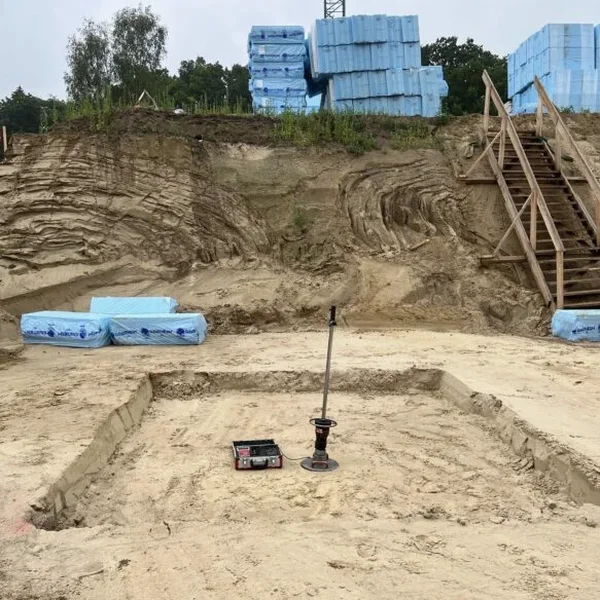
Technical reference image — Halifax

Local considerations

Compaction failure in Halifax follows a pattern. The south end, with its slate bedrock and thin till cover, rarely surprises. But the clay plain around Fairview Cove and the filled ravines in Clayton Park are different. Loose, undocumented fill from the 1970s sits over compressible marine clay. If the Proctor curve was developed on a blended sample that doesn't represent the actual fill, the field density test will pass while the fill settles later. Another risk is moisture control during wet weather. Halifax averages over 1,400 mm of precipitation annually. A stockpile can go from optimum to saturated in one rainstorm. The lab re-runs the Proctor when the source material changes. That's the spec. CSA A23.1 references ASTM D698 for structural backfill. The NBCC requires compaction to 95% or 98% of standard Proctor maximum dry density for foundation support, depending on the bearing stratum classification.
Need a geotechnical assessment?

Reply within 24h.

Email: contact@geotechnicalengineering.vip

Technical parameters

ParameterTypical value
Test standardsASTM D698 (Standard), ASTM D1557 (Modified)
Mould sizes4-inch (Method A/B), 6-inch (Method C)
Compactive effort (Standard)12,400 ft-lbf/ft³ (600 kN-m/m³)
Compactive effort (Modified)56,000 ft-lbf/ft³ (2,700 kN-m/m³)
Material suitabilityUp to 30% retained on ¾-inch sieve (Method C)
Moisture determinationOven drying at 110 ± 5°C per ASTM D2216
Typical MDD range (Halifax till)1,850 – 2,150 kg/m³
Typical OMC range (Halifax till)8% – 14%

Associated technical services

01

Standard Proctor (ASTM D698)

Laboratory compaction test using 12,400 ft-lbf/ft³ effort. Establishes maximum dry density and optimum moisture for general fill, landscaping, and residential slabs. Three-point curve minimum.

02

Modified Proctor (ASTM D1557)

Higher compactive effort (56,000 ft-lbf/ft³) for structural fill, highway embankments, and airfield pavements. Method C for material with oversize particles up to ¾-inch.

03

Field Density Correlation

Sand cone (ASTM D1556) or nuclear gauge (ASTM D6938) testing at the fill pad, referenced against the lab Proctor curve. Percentage compaction calculated on-site.

Applicable standards

ASTM D698-12 (Standard Proctor), ASTM D1557-12 (Modified Proctor), CSA A23.1/A23.2 (Concrete materials – compaction of fill), NBCC 2020 – Division B, Part 4 (Earthwork)

Frequently asked questions

What does a Proctor test cost in Halifax?

A standard Proctor (ASTM D698) typically ranges from CA$120 to CA$180 per sample. A modified Proctor (ASTM D1557) runs CA$200 to CA$300. The price depends on the number of points on the curve and whether oversize correction is needed.

How many Proctor tests are needed for a typical building site?

One Proctor per distinct material type. If the fill source changes, or if the material visually shifts from sandy till to silty clay, a new test is required. A typical Halifax project on glacial till uses one to three curves.

What moisture content should Halifax fill be compacted at?

The optimum moisture comes from the lab Proctor curve, not a generic number. Halifax glacial till often shows an optimum between 8% and 14%. Field compaction targets ±2% of that value for cohesive soils and ±1% for granular fills.

Location and service area

We serve projects across Halifax and surrounding areas.

View larger map