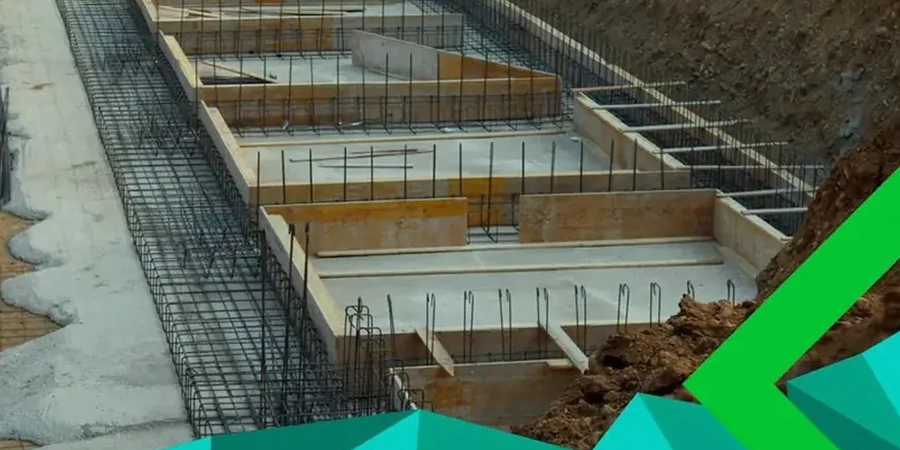
Shallow foundation design in Halifax requires direct confrontation with the regional bedrock geometry. The National Building Code of Canada (NBCC 2015) mandates a bearing resistance limit state check, but the real challenge here lies in the Goldenville and Halifax slate formations. These metasedimentary rocks dip steeply and weather into a compressible residual soil mantle that varies from 0.5 to 4 meters thick across the peninsula. A standard spread footing bearing pressure of 150 kPa is often assumed and frequently wrong. We verify the actual allowable bearing capacity through site-specific investigation, correlating SPT N-values from the overburden with unconfined compressive strength tests on rock core. On slopes facing the Northwest Arm, eccentricity and sliding checks dominate the design because the weathered shale loses strength rapidly when exposed to freeze-thaw cycles. The city’s glacial history left an erratic till layer that can mask pinnacled rock, creating differential settlement risks that only a detailed drilling program can resolve. We pair our bearing capacity analysis with test pits excavation to visually log the contact between till and bedrock, ensuring the foundation subgrade is uniform before a single cubic meter of concrete is poured.
A 150 kPa bearing pressure assumption on weathered Halifax slate can underestimate settlement by 300 percent if the pinnacled rock surface is not mapped.
Process and scope
Halifax was rebuilt on its own rubble after the 1917 Explosion, and much of the downtown infill contains brick fragments, ash, and uncontrolled granular debris. This anthropogenic layer sits directly above the natural till, creating a two-layer bearing problem that shallow foundations must bridge. We characterize the soil profile using grain size distribution per ASTM D6913 and Atterberg limits per ASTM D4318 to quantify the silt content in the till matrix. A typical Halifax till runs 15 to 25 percent fines, which puts it right on the borderline of frost-susceptible soil under the NBCC climate data for the region. Our design sets the underside of the footing a minimum of 1.2 meters below finished grade to stay beneath the frost penetration depth. For strip footings on sloping terrain in Clayton Park or Fairview, we apply the Brinch Hansen bearing capacity equation with inclination factors derived from the actual slope geometry, not a textbook assumption. The proximity to the harbour means groundwater is often perched within the fill, so we run consolidated-undrained triaxial tests to obtain effective stress parameters for the settlement prediction. A single pad footing on intact Halifax slate can sustain over 500 kPa, but the same footing placed three meters away on weathered slate might fail at 200 kPa. That spatial variability drives our investigation grid density.
Regional considerations
The most common mistake we see in Halifax foundation design is ignoring pyritic shale. A contractor excavates, finds grey rock, assumes it's competent slate, and pours a footing directly on it. Two years later, the slab heaves. The pyrite in the Halifax slate oxidizes when exposed to air and moisture, forming gypsum and sulfuric acid, which expands the rock mass by up to 10 percent of its volume. The NBCC 2015 does not give you a simple equation for this. You need a total sulfur content analysis from the rock core, and if the sulfur exceeds 0.5 percent, you isolate the footing from the rock with a granular buffer layer. Another failure mode we investigate is local bearing failure at the edge of a cut-and-fill terrace. Many older Halifax lots were leveled by cutting into the slope and placing uncontrolled fill at the toe. A shallow footing that straddles the cut-fill line will rotate toward the fill side as it compresses. We catch this with a dense SPT grid and recommend a deepened perimeter footing or a structural slab to bridge the transition. Liquefaction is not the primary hazard in Halifax, but the loose fill in the harbourfront area can lose strength under the 1-in-2475-year seismic event defined in NBCC, triggering a settlement-driven serviceability failure rather than a bearing collapse.
Common questions
What is the typical bearing pressure for a house foundation on Halifax till?
For a dense glacial till with SPT N-values above 25 blows per 300 mm, we typically recommend a factored bearing resistance of 150 to 200 kPa for a strip footing at 1.2 m depth. The exact value depends on the fines content and proximity to bedrock pinnacles, which we verify with a test pit or borehole at each corner of the proposed structure.
How much does a shallow foundation design cost for a residential project in Halifax?
Do I need to worry about frost heave for a shallow foundation in Halifax?
Yes. Halifax has a frost penetration depth of approximately 1.2 meters as defined by the NBCC climate data for the region. Any shallow foundation must have its bearing surface below this depth. If the natural soil within this zone is frost-susceptible (more than 10 percent finer than 0.075 mm), we specify a non-frost-susceptible granular backfill around the foundation walls to prevent adfreezing and heave.
What is pyritic shale and why is it a problem for Halifax foundations?
Pyritic shale is a sedimentary rock unit within the Halifax Formation that contains iron sulfide minerals. When excavated and exposed to oxygen and water, the pyrite oxidizes to form sulfuric acid and gypsum, a reaction that expands the rock volume by up to 10 percent. This expansion can lift a foundation slab or crack a footing. Our design protocol requires total sulfur testing of rock core and, if reactive, isolation of the foundation from the rock with a compacted granular buffer and vapor barrier.